Monday, January 5, 2009

Corrugated Rib

Recently, I test knit a corrugated rib hat for Amy. Corrugated ribbing is ribbing with the purl sts in one color and the knit sts in another.

Since I'd never done any corrugating ribbing before, I searched the web for info. Here are my adventures in making the hat:

First comes the supposed problem with curling and with strands peeking out from the edge. After a few attempts, I ended up with a knitted cast on (though a single cast on would work as well, and also, I suppose, a cable one).

Then, more importantly (to prevent curling), I did one round in k1p1 ribbing with the same color -- dark gray.

After this round, I added the second color. I tried having the purl color in my right hand -- but found it very difficult for me to purl English style. (I generally knit Continental style.) So, I ended up with the purl color (white) in my left hand and the knit color (dark gray) in my right hand. It worked out well -- and was surprisingly relatively fast and easy. The second picture shows both the right and wrong sides of the hat.

I used Patons Classic Wool Merino and size 7 needles. There is no problem whatsoever with curling and my DD has a nice warm stylish hat.

Tuesday, December 23, 2008

Picking up sts from a cast-on edge

Here's an alternative way of picking up stitches from a cast-on edge. The main advantage to this technique is that it can be done in pattern -- in this case, a "k4, p3" pattern.

The easiest cast-on edge to pick up from, using this technique, is a single (or backwards loop) cast on. The single cast on has less bulk as well. (The long-tail cast on would work as well since it looks exactly like a single cast on followed by a row of knitting.)

I'll be illustrating the technique for the bottom of an armhole for a raglan worked from the top down. The first picture shows the bottom of the armhole half done. The other half will be picked up after knitting around the rest of the armhole -- so that rounds will begin and end at the middle of the underarm.

The first step is to identify the 2 loops of yarn over the first stitch to be picked up -- in this case, a knit stitch.

One of these loops starts out as the right-hand-side of the stitch and then travels left over the stitch. The other starts out as the left-hand-side of the stitch and then travels to the right.

The second picture shows a crochet hook ready to pull yarn through the top of a knit stitch.

Once the loop is pulled through, place the yarn over the waiting needle so that the free end of the yarn (as opposed to the loose end) lies behind the needle. The part of the yarn nearest the loose end lies in front of the needle.

The next stitch to be picked up is also a knit stitch. The 3rd picture shows the progress after 2 knit stitches have been picked up.

The next stitch to be picked up is a purl stitch.

For purl stitches, the technique is a bit different.

Bring the yarn to the front of the work. Draw the yarn from front to back through the 2 loops at the top of the stitch. (The loops can be seen more easily from the back of the work.)

The last picture shows the progress after 3 sts have been picked up. The next 2 sts to be picked up are also purl sts. So, the yarn should remain in front while picking up the stitches.

The last 2 sts to be picked up before working the sides and top of the armhole are knit stitches. The yarn should be moved to the back before picking up these stitches.

For the corner of the armhole, I haven't made up my mind whether or not to pick up one more stitch before knitting sts off the cable. Sometimes I pick up one more stitch from the same row; sometimes I don't.

Whichever, ..... I like to knit together the last picked up stitch with the nearest stitch on the cable (and also the first stitch to be picked up on the opposite side of the armhole with the nearest stitch on the cable).

To start working off the cable, of course, remove the cap on the cable and replace it with a needle (the same size or a smaller size than the one used to pick up sts). Slip the nearest stitch from the cable onto the needle used to pick up stitches. Then pass the second st on the needle (the last one picked up) over -- (or else, ssk). Work around, in pattern -- except, slip the last stitch on the cable onto the working needle. Pick up 1 st from the unworked side of the armhole. Place these 2 sts on a spare needle, pass stitch over, return the remaining st to the working needle (or else, k2tog)-- a mirror image of what was done on the opposite side of the armhole. Pick up the rest of the stitches at the bottom of the armhole, and begin working in the round.

Thursday, November 6, 2008

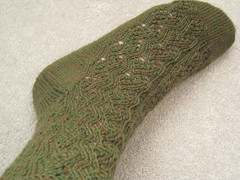
Bamboo waves sock

This sock is worked from the toe up. It uses a variation of the September 2008 stitch pattern by Gail Dennis aka Sockamaniac and has a Widdershins heel.

edited: Whenever, I reknit something, I can't help but change it a little. A new version of the pattern is available for free on Ravelry. It is now sized in multiple sizes, has a different way of making the leg increases, and has an eyelet cuff. Here is a pic (in Knit Picks Stroll yarn):

Bamboo Waves Socks

The original (shown below) is knit from yarn courtesy of a lady from the knitting group I belong to and owner of
My Small Wonders (which is where the yarn in the pic comes from). She wanted to see what her hand-painted yarn would look like knitted up into sock. The yarn was a pleasure to work with. Here's the pattern that resulted:

Materials:
1 skein (100g) sock yarn
two size 1 circular needles

Gauge: 8 sts and 12 rows per inch (Row gauge is not important.)

Pattern (5 sts by 12 rows):
All even rows: Knit across
Rows 1, 3, 5: yo, k1, yo, ssk, k2tog
Rows 7, 9, 11: ssk, k2tog, yo, k1, yo
Reverse Pattern (5 sts by 12 rows):
All even rows: Knit across
Rows 1, 3, 5: ssk, k2tog, yo, k1, yo
Rows 7, 9, 11: yo, k1, yo, ssk, k2tog
The pattern is abbreviated "patt". The reverse pattern is abbreviated "rev patt".

Toe:
Cast on 7 st on each needle using Turkish cast on.
Knit around.
Increase every round to 13 sts per needle.
Increase every other round to 31 sts per needle.
Knit even to about a 3" length (about 14 rounds)

Foot:
On needle 1: k2, patt, k2, patt, k3, rev patt, k2, rev patt, k2 (31 sts). On needle 2: k across.
Continue until the length is about 2 1/2 " (30 rounds) shy of the total desired foot length. For where the 30 rounds comes from, look at my post on the Widdershins heel.

Gusset:
Make gusset increases every other row to 53 sts on Needle 2. Meanwhile, keep following the pattern on Needle 1. The last pattern row on Needle 1, before turning the heel, should be an even row. Do not knit across on Needle 2. Instead .....

Turn heel:
Place markers 15 sts in from either side of Needle 2, leaving 23 sts between markers. The stitches between markers are the heel sts. The sts outside the markers are the gusset sts. Then, working only on the heel sts:

Row 1: k to 4 sts before marker, kfb, k1, turn
Row 2: s1, p to 4 sts before marker, pfb, p1, turn
Row 3: s1, k to 4 sts before gap, kfb, k1, turn
Row 4: s1, p to 4 sts before gap, pfb, p1, turn

Repeat Rows 3 – 4 until there are 31 sts between markers.
(On purl rows, s1 – slip 1 purlwise with yarn in front. On knit rows, s1 - slip 1 knitwise with yarn in back.)

Heel flap:
Row 1: s1, k to last heel st, ssk last heel st and 1 st from left gusset, turn
Row 2: * s1, p1 * to last heel st, p2tog last heel st and 1 st from right gusset, turn

Repeat Rows 1 – 2 until there is only 1 st to be picked up, a right gusset st. (You'll be ending with Row 1.) Do not turn. Work the next pattern row on Needle 1. When you reach Needle 2 again:

k2tog (to get rid of the last gusset st), * k1, s1 * across.

The heel is now finished.

Leg:
Continue working in the round. Work same pattern row on Needle 2 as was worked on Needle 1. To increase, change an ssk or k2tog to a k2.
1st pattern repeat, increase on row 11 between side zig-zags.
2nd pattern repeat, increase on row 11 on outsides.
3rd pattern repeat, no increase
4th pattern repeat, increase on row 1 in the middle and then on row 11 between side zig-zags
5th pattern repeat, increase on row 11 on outsides.
6th pattern repeat, no increase
There are now 41 sts on each needle.

Cuff:
The cuff has k1, p1 ribbing. But, to get the purl stitches over the yo's, there are three p2tog's.
Next round:
k1, p2tog, (k1, p1) twice, k1, p2tog, (k1, p1) 8 times, k1, p2tog, (k1, p1) 5 times -- on each needle
Next 9 rounds: (k1, p1) around
Bind off.

Wednesday, July 23, 2008

I-cord cast on

I've made an i-cord cast on once before but wasn't entirely happy withthe result. So, this time, I decided to look for another method. Ifound one that used M1 into the first stitch instead of kfb. But, Iwasn't entirely happy with that one either. So, I asked myself "whydoes the M1 have to be into the first stitch?"

Here is my new and different way of making an 3-stitch i-cord cast on:
1. Cast on 4 stitches.
2. Slide the stitches to another dpn or to the other end of a circ (just as you would to make an unattached i-cord).
3. k3
4. Wrap the yarn around the LHN (left hand needle) as in the picture by wrapping the yarn over the needle from the back and then under the needle again. The yarn starts out in back and ends in the back of the work.
5. Slip the 3 stitches on the RHN (right hand needle) back to the LHN purlwise.

Repeat steps 3 - 5 until there are the LHN has on it the desired number of stitches to be cast on plus 2.
To end, you can then k2tog, k1, return the stitches to the LHN, k2tog, and then return this stitch to the LHN.

Wednesday, August 22, 2007

Summer Square boatneck raglan

This is a summery extra-short sleeve raglan. The directions are for a medium size and worsted weight yarn (with a gauge of 4 sts per inch) and size 7 needles. Size 5 needles are used for the sleeve finishing. I used 7 skeins of shine worsted yarn (525 yds). Most people would need 8 skeins.

It can be made larger/smaller by either doing more/fewer increase rows in the raglan shaping section or casting on more/fewer sts. (If casting on more/fewer sts, try to leave the neckband ratio similar. In this pattern, there are 33 sts for the front/back panel and 11 sts for each sleeve -- a ratio of 3 to 1. So, one could decrease to 27 and 9 -- again a ratio of 3 to 1 and again both odd numbers. One could also increase to 39 and 13.)

It's not necessary to work the pattern. I added it because I thought I'd get bored doing straight stockinette for the rest of the pullover. A blog entry on the pattern is here. It includes a variation of the chart made before I realized that charts are read from the bottom right corner up and across. It also includes a discussion on the best way to join yarn for a slippery cotton blend.

Neckband:
CO 92. Join.
Work *p1, k1* around for 6 rounds, starting w the p1.
*p1, k11, p1, k33* twice
p92

Upper Body:
R1: *P1, k1, m1, knit to 1 st before next purl, m1, k1* four times.
R2: Knit the knit sts and the m1's, purl the 4 purl sts

Alternate these rnds to 34 increase rnds total and 228 sts total. Then do just R2 until 45 total rnds for me (51 for most people) not including the ribbing – or until the sweater lies 1” below the underarm. Then: p1, *k3, p3* around, k3, p2 (R1 of both the sleeve and garment pattern).

Lower Body:
*K1, put the next 47 sts on a spare circ, co9, k67* twice (152 sts total). This is R2 of garment and garment underarm patts. (The 47 sts to be put aside are the sleeve sts.)

The pattern chart doesn't show up well here. Another version is here. Click on the chart to see a close-up. A picture of the sweater is at that link and as the second sweater in the link here.

Continue w R3 of garment and garment underarm patts. (Every even rnd is knit around.)

After the patt rnds, continue shaping by decreasing 4 sts every 10th row above the waist and increasing every 5th row below to end with 152 sts at desired length.

Lower Garment Ribbing:
set-up round: *(k1, p1) twice, k1, p2tog, (k1, p1) twice* around, ending either w (k1, p1) or (k1, p2tog)
*k1, p1* around for 14 rnds.
Bind off.

Sleeves:
Use a needle 1 or 2 sizes smaller than for the rest of the garment. Starting with the middle stitch, knit 4 sts from the underarm cast-on sts, knit the last cast-on st together with the nearest sleeve st, knit to the last of the sleeve sts, knit that together w the nearest cast on stitch, and then knit 3 sts to reach the middle again. (54 sts) (This is R2 of the sleeve pattern.) Continue with R3 of the sleeve patt. (Every even rnd is knit around.)

Bind off.

Friday, June 15, 2007

K3P2 Boatneck Pullover

This is a favorite pattern. The idea came originally from knitty.com's Bob. The version I made (in the May 2004 archives of this journal) is the first sweater I made that my oldest complimented me on as being stylish. That one was knitted from the top down and in the round, just as this one is.

I've learned a lot of new techniques since then. So, the pattern for this sweater is slightly different from the one I used back then. It's so much different that I decided to write it down here.
The yarn I used is Patons Classic Merino New Denim -- which was a pleasure to work with and a pleasure to wear. I used size 7 circulars and had a gauge of 4 sts and 6 rows per inch.

Neck:
CO 70. Join to work in the round.
K1, *p2, k3* 13 times, p2, k2 for 10 rounds.
Place marker after 2nd, 7th, 37th, and 42nd sts. (Each marker will be between 2 purl sts. These markers mark the centers of the raglan seams.)

Upper garment:
The raglan seams are k1, p1, (marker), p1, k1. Increases are made outside of the raglan seams on increase rounds, as follows: On increase rounds, work: m1, k1, p1, (marker), p1, k1, m1 with the m1's made to continue the p2, k3 pattern on the sleeves and garment. On the first increase round, each m1 is m1 knit. On the next two increase rounds, each m1 is m1 purl. For the next three increase rounds, it's m1 knit. ....

For a wider neckline:

Neck:
CO 80. Join to work in the round.
K2, *p2, k3* 15 times, p2, k1 for 10 rounds.
Place marker after 3rd, 13th, 43rd, and 53rd sts. (Each marker will be between 2 purl sts. These markers mark the centers of the raglan seams.)

Upper garment:
The raglan seams are k2, p1, (marker), p1, k2. Increases are made outside of the raglan seams on increase rounds, as follows: On increase rounds, work: m1, k2, p1, (marker), p1, k2, m1 with the m1's made to continue the p2, k3 pattern on the sleeves and garment. On the first two increase rounds, each m1 is m1 knit. On the next two increase rounds, each m1 is m1 purl. For the next three increase rounds, it's m1 knit.....


Alternate increase rounds with non-increase rounds to get a total of 20 increase rounds. Then k3p2 around in pattern until garment top is desired length. End with k3 before the first p2 (the center of the first raglan seam).

Lower garment:
Cast on 12 sts. Put the (purl) stitch before the first marker, plus the stitches between the first and second marker, plus the (purl) stitch after the second marker on a spare circular needle or scarp yarn. Work in pattern to one stitch before the third marker. Cast on 12 sts. Put the (purl) stitch before the third marker, plus the stitches between the third and fourth marker, plus the (purl) stitch after the fourth marker on a spare circular needle or scarp yarn. Work in pattern around. (150 sts on main circular needle.)

Work k3p2 ribbing for 14 rounds. On 15th round p2tog two p2 sts under each underarm
Start working in stockinette, doing double decreases under each underarm every tenth round until reaching natural waist. (My natural waist falls at 50th round and so I did a total of 4 double decreases.) Work evenly for about an inch. Make double increases under each underarm every fifth round until reaching the original number of stitches.
Work k1p1 ribbing for 6 rnds. Bind off (w decrease bind off)

Sleeves:
Starting with the center underarm, pick up and knit/purl in pattern until reaching the sts on the spare circ or scrap yarn. Pass the first two of these sts over the last st worked. Work in pattern to the last two sts in scrap. Slip these sts (to be passed over the next st worked). Pick up and knit/purl in pattern the rest of the underarm cast on sts – passing the two slipped sts over the first of these worked underarm sts. Work in pattern until sleeve is desired length (for a short sleeve, 20-30 rnds). (If I were to make this into a long-sleeve or ¾ sleeve pullover, I would work the ribbing until just above the elbow, then decrease evenly around by about 10%, then work in stockinette decreasing every inch or inch and a half, and finally work a p1k1 ribbing at the cuff – in order to match the sleeves more or less to the body of the sweater.) Bind off (w decrease bind off).

Thursday, May 17, 2007

OJ - drop-sleeve pullover

Every so often, there is a request on knitting boards such as knittyboard.com for an easy-to-make sweater. This is one of the easiest. The pattern itself is such that it can be made with almost any yarn and in almost any size. The sweater pictured is the 3rd sweater I ever made. The second sweater I ever made was to the same pattern. But, it's no longer with us. I accidently washed it on too high a heat setting and because of its acrylic content, it blossomed to twice its original size. The sweater pictured is too big for me. I made it before I learned to adjust a pattern. The stripes are optional. (There are a lot of major changes in the pattern below from the original pattern.)

Generic Drop-Sleeve Boat-Neck Pullover

The garment front and back are essentially large rectangles with ribbing at both top and lower edges. These are knit first. Then the top (leaving an opening for the neck) and the sides (leaving an armhole opening on each side) are seamed up. Last, stitches are picked up around each armhole to begin the sleeves. (I use 2 circular needles of the same size to make the garment.)
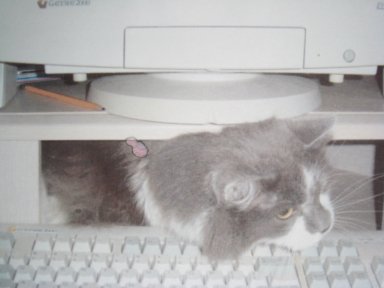
The pullover is named after a cat of ours who used to help me knit by lying on top of the yarn.

1. Calculate your gauge. Then decided how wide around you want the sweater to be.

2. Calculate the sweater circumference.

A gauge of 4 sts and 6 rows per inch and a width of 36”.would give 4 x 36 = 144 sts.
Half of these belong to the front and half to the back – 72 sts for the front.

Because of the ribbing pattern at the top, we want an odd number of sts on both front and back.

Add a st to give 73 sts for the front.

3. Then decide on how many sts to cast on for the front. Because of the nature of ribbing in general, cast on approximately 10% fewer sts

90 % of 73 is 65.7. So, cast on 66 sts.

4. Work k1, p1 ribbing for approximately 2". The knit 1 at the beginning and end of each row, except the first will make seaming easier (although some people prefer starting each row with a slip 1).

Row 1: K1, *p1, k1* 32 times, k1
Repeat Row 1 approximately 14 times. (edited: 13 Dec 2007)

5. Increase evenly across to an odd number of stitches.

Increase from 66 sts to 73 sts across.
K1, *p1, kfb, (p1, k1) 4 times*, repeat * to * across row, ending with k1
kfb is knit into the front and then the back of a stitch)

6. Knit body of sweater. (Until now the sweater has no right/wrong side.)

Row 1 (RS): K73
Row 2 (WS): K1, p71, k1
Repeat these rows until the sweater is 3 - 4" inches less than the desired length. End with a RS row.

7. Work top ribbing for 3 - 4". Bind off later.

Row 1: K1,*k1, p1* 35 times, k2
Row 2: K1, *p1, k1* 36 times
Repeat Rows 1 and 2 -- 11 times, approximately. Place sts on scrap yarn or a spare needle. Leave long enough tail to bind off 49 sts (2/3 of the sts).

8. Work sweater back the same as the front. (I worked back and front at the same time.)

9. Seam up garment top edge, leaving enough room for the neck. (Try on the garment with the top pinned together about a fourth of the way from each shoulder.)

Place garment right sides together. There will be a tail of yarn at each shoulder. Starting at one of the shoulders, bind off 20 sts from front and back (at the same time) using a 3-needle bind off. Then bind off 33 more sts from the part of the garment furthest away (using perhaps the decrease bind off). There are now 20 sts left on the back needle. Repeat this process starting at the other shoulder and the other yarn tail.

10. Seam up garment sides, leaving room for the sleeves. (Try on the garment to help decided how big a hole to leave for the sleeves.)

You can stop at this point and weave in all loose ends. The result is a nice-looking shell.

11. Pick up stitches to begin knitting a sleeve from the armhole down, starting at the bottom of the armhole. Because of the gauge, pick up 4 sts for every 6 rows on the armhole opening. Also, pick up an extra stitch at the garment side seam and the garment top seam. The total number doesn't matter, just so the same number of stitches are picked up when doing the other sleeve.

12. Knit the sleeves. Mark the starting point. This is the beginning of all rounds. For a tapered sleeve, make decreases every inch and a half, approximately.

Rounds 1-8: Knit around
Round 9: K1, k2tog, k to last 3 sts of round, ssk, k1
Repeat these 9 rounds until sleeve is desired length.

13. Make sleeve ribbing and bind off.

Round 1: *K1, p2 tog, k1, p1* around, ending either with k1, p1 or k1, p2tog
OR -- Round 1: *k1, p2tog* around, ending with k1, p1 or k1, p2tog or k1, p3tog
Round 2: *K1, p1* around
Repeat Round 2 for about an inch and a half. Bind off.

14. Make second sleeve the same as the first.